How to Submit Art to the Mn State Fair
Amid the racket, smells and crowds of the Minnesota State Off-white, the Fine Arts Exhibition is a world of its own. Pace within the red brick building on the corner of Randall and Cosgrove and things slow downwards – your anxiety, your breathing, perchance even your middle rate. You're non there to eat, beverage, ride, scream, rock out, pat a cow or win the biggest prize on the Midway. Y'all're there to look at fine art.
How much art? For 2021, 321 items. Breaking it downwardly: 110 photographs, 98 oil/acrylic/mixed media works, 29 drawings/pastels, 23 watercolors, 19 sculptures, 15 works in textile/fiber, xiv in ceramics/drinking glass and 13 prints, chosen by eight jurors from two,462 works submitted by Minnesotans from all over the state.
That's several hundred more than the 1,718 submitted in 2020, the first year of the pandemic. Co-ordinate to Jim Clark, information technology's in line with the six-twelvemonth average before COVID.
In 2020, the fair was canceled merely the Fine Arts Exhibition was open up to visitors with timed tickets. "We had some things in place already that fabricated that feasible," Clark said, "and so we made the other stuff up as we went." A itemize and a virtual tour were offered online.
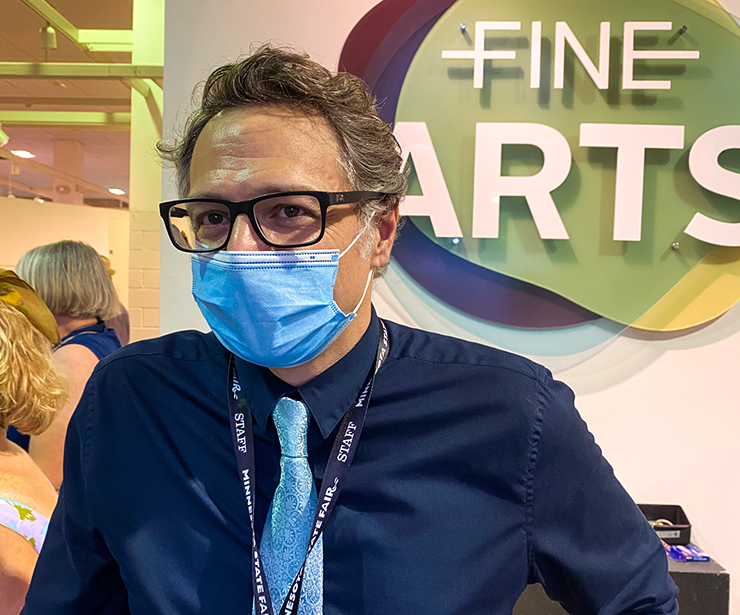
Jim Clark is the homo in charge. The fair's fine arts superintendent since 2011 – before so, he lived in Alaska for several years, and before and so, he was a staffer for the Fine Arts Exhibition – Clark does information technology all, from hiring the jurors to hanging the show. His full-time job is principal visual arts administrator at the Hopkins Heart for the Arts, where he besides teaches drawing. He'southward a practicing artist who recently completed a commission for Betty Danger's rebranding. In short, he says, "I work every day."
He made time for an in-person interview at the Fine Arts Building terminal week, during which we learned a lot about our favorite function of the fair.
On the way things used to be
Jim Clark: For 100 years, each and every piece of work in contest was manus-delivered. The concluding twelvemonth we did that was my kickoff year every bit superintendent, 2011. We handled physically more 2,000 works.
That wasn't great for many reasons. The jurors came in for a single day. The jurors in the larger classes, like painting and photography, were looking at 800 pieces of art in a unmarried day. For the artists, including the artists of Greater Minnesota, in that location was an 85% chance historically that you would take to come back the very next weekend to option up your work.
If you lot get into the 2d round, it'southward a greater than l% adventure, typically, that you lot'll exist in the show.
What we did [in 2012] was plant a digital start circular. Jurors had v days. They could log in, see their class or category, rate them, rerate them, sort them by rating, look at them for a day, get abroad from them for a day and come back.
Merely the best mode to feel any art is in life, let solitary to evaluate it, then we retained the live jury day. The jurors select twice as many pieces every bit can fit [in the testify] to bring in so they can meet them in life. From those, the works on display are chosen.
For the last two years, due to COVID, we've gone with 100% digital for credence only retained the in-life for awards. A lot of artists like the convenience of that.
On who can enter the show
JC: You but need to be a Minnesota resident. That includes students, besides. Some of the programs here at the fair pull entrants from Wisconsin and Iowa. Nosotros don't do that.
Nosotros don't accuse an entry fee, and that'south unusual. Most opportunities in this field, you lot pay to participate. There are fewer boundaries to participate in this testify than only about whatsoever other that I can call up of.
On how jurors are called
JC: I consider their feel, their body of work, their education, and that they're practicing artists in that field. Sometimes information technology'll be someone that's been at their work for forty years, they never got an MFA or fifty-fifty a BFA, just they accept a rich experience. Other times information technology's someone that's a bit younger, but they may have their terminal degree in their field, or they teach. People that teach tend to accept a good, wide spectrum of understanding.
On multifariousness, equity and inclusion
JC: We modify [jurors] every yr. We attempt to gather people from all unlike types of backgrounds so the jury group is reflective of the rich tapestry that is Minnesota artists.
We don't collect information from entrants on their groundwork, ethnicity, race – whatsoever of that. I've considered we might do that, at least by ballot, so we might accept a better understanding of the constituents that are participating. I truly believe in recognizing the individual the fashion they'd like to be recognized. We are all navigating that.
"Studio: Hither" is a special exhibition we didn't take last year, but this will be the ninth year where nosotros've invited 12 different Minnesota artists to come in, i for each day of the fair. They employ a portion of our gallery equally their working studio space. Information technology's an opportunity to show the public the nuts and bolts of fine art-making, that art-making doesn't always expect like one assumes fine art-making looks. People of colour are role of that program as well.
[Note: Onetime MinnPost writer Andy Sturdevant (The Stroll) volition exist the featured artist on Thursday, Sept. ii.]
On who comes to the show
JC: Nosotros get everybody through this edifice. Defended gallery goers, art-savvy people, art-sensitive people. We also go a ton of people [for whom] this is their 1 and but feel with art in a twelvemonth, and we don't have that responsibility lightly.
On the layout of the evidence
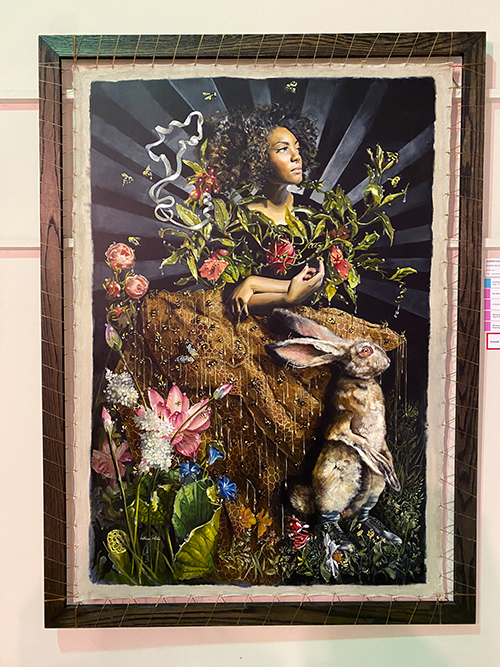
JC: I believe it was Bob Lesch who came up with the floor plan. He was the superintendent when fine arts moved from the grandstand to here in 1980. It hasn't changed much since then, and there'south a reason for that: It works. And information technology seems dissimilar every year.
People come in and they're like, "Oh, it seems so much more open!" or "The walls have changed!" just they haven't. The walls could change; they are modular. A lot of people would like it to exist just straight rows. But it'southward a dynamic experience, and your vistas change.
I know that 90% of the world comes through that door and goes around in counterclockwise way, but information technology'due south non designed to be linear. Actually, it'southward circular.
On the chances of a virtual tour this year (people on Facebook are asking nigh that)
JC: The itemize volition be online, just not the tour. The fair puts an incredible corporeality of resource into this evidence. Nosotros desire people to see it because seeing art in life is the best way to experience it. We want people to buy a ticket [to the fair] and come see it. That supports the fair and keeps us going.
[This bear witness pays artists] $10,000 in awards and prizes. Information technology pays tens of thousands of dollars to staff. The jurors are paid. I have a few volunteers who practise information technology simply for the fun of it.
This is only the second year the catalog volition be online. I tin't say that information technology will be in perpetuity. A large part of the thinking was the treatment of cash [during the pandemic]. Nosotros normally sell the catalog for two bucks, and we're lucky to break fifty-fifty.
On hanging the prove
JC: It's the best part of the gig because it's a creative act. So yeah, I enjoy information technology.
As I mentioned, nosotros get everyone through this building, and a lot of times people wonder why the honor winners aren't all in one spot, or why the show isn't organized by subject matter or medium. Why aren't all the pictures of fish together? Because a typical viewer is going to await for the best image of a fish. Every work in here we feel is deserving of attention.
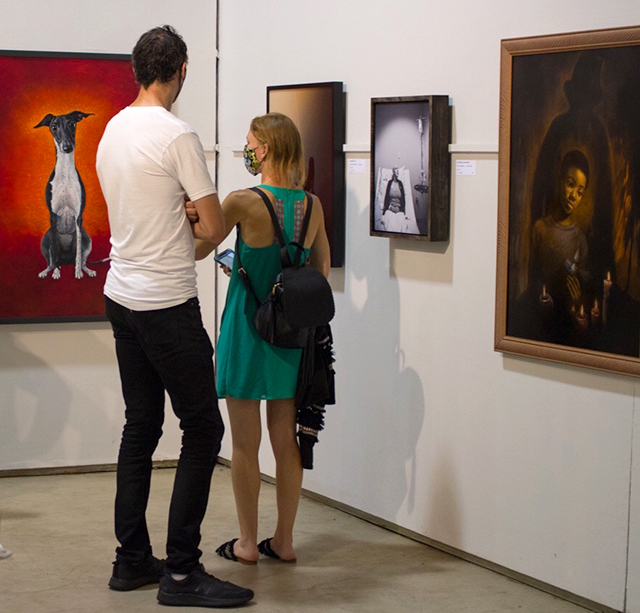
Our goal is to curate a viewing experience that helps maintain energy level. Information technology'due south really piece of cake to get into the zombie walk at the off-white. You're full of corndogs and whatnot, it's hot, and you get the zombie shuffle going. So I look for diversity and visual sympathies and affinities. Then there needs to be some change, but it tin can't be so abrupt as to be jarring.
I think of each wall as a visual sentence. If you have all 4-letter of the alphabet words, that's going to be a pretty boring thing to read, correct? We like to change the sizes [of the fine art] considering yous're suddenly coaxing an up-and-down movement to the eyes instead of simply forth the line, so people are really looking.
The big thing nowadays is interactivity. Everything's got to exist interactive. I'm aiming for an active viewing experience. It shouldn't be a dingy discussion to wait and await hard, and that'southward what nosotros're trying to practice.
And so at that place are the existing conditions. These are the puzzle pieces. Now nosotros have to make them fit together. And in every year, because I appoint with [the bear witness] every day for a lot of hours, I e'er run into something and retrieve, 'Oh, I wish I would accept made that move!" Fifty-fifty on the last twenty-four hour period, I'll be like, "This would have been proficient!"
In a nutshell: Visual sympathies or affinities. Contrasts to coax or nurture as active a viewing feel as possible, and to ensure that each work gets its full due. Every year, there are works the jurors choose and I'one thousand, similar, really? Simply it'southward my job to make each and every work sing, speak and present likewise every bit it peradventure tin.
Source: https://www.minnpost.com/artscape/2021/08/secrets-of-the-state-fair-fine-arts-show/

Post a Comment for "How to Submit Art to the Mn State Fair"